Author: Sam Trail
Date: August 24, 2026
Peer over the railing from Florida Atlantic University Marine Lab’s visitors’ gallery and you might see some new guests to our lab space: coral! Dr. Carsten Grupstra started at Florida Atlantic in January 2025 and has refurbished a portion of the FAU Marine Lab for his staff, students, and postdoctoral research fellow to investigate coral, coral relatives, and coral “collaborators” (aka symbionts such as algae and bacteria). Research in the Grupstra Reef Symbiosis Lab is centralized on one big question: “What drives coral resilience?”
Grupstra grew up in the Netherlands with a handy, boat-builder dad and a fashion designer mom, not knowing that he could make a career of asking such biological questions. While at university, he had the opportunity to go SCUBA diving in Thailand, and there was no looking back – he was hooked, and he was going to be a marine biologist! Grupstra’s subsequent research has taken him all over the world to study coral in Curacao, Spain, French Polynesia, Saudi Arabia, Palau, and Panama, just to name a few.
“The ability to travel to so many places is amazing…I’m really lucky I got the opportunity, for sure,” reflected Grupstra. “I never thought I would end up in the United States, but I really love it.”
He applied to his dream Ph.D. position at Rice University in Houston, Texas where he studied viruses that live inside corals. He has made the United States his home ever since, although he still might travel to other beautiful places. The coral research conducted by Grupstra and his students focuses on what can be done to increase coral resistance to environmental stressors in Florida, particularly those caused by the rise in global water temperatures.
“Coral are closely related to jellyfish and anemones. They are colonial and clonal, so they make these big kinds of ‘fortresses’ out of calcium carbonate. Symbionts live inside and feed the coral using photosynthesis to make sugar out of carbon dioxide and sunlight. Coral cannot live long without the symbionts, and the symbionts often can’t thrive without the coral. When coral bleaching occurs due to high temperatures, the symbionts leave. If they don’t return, the coral dies and the symbionts often die too,” explained Grupstra.
Grupstra then compared these coral “fortresses” to a bakery, “It may be more accurate to think of coral as a bakery with pastry chefs – when the chefs (symbionts) leave, the bakery has to shut down.” However, some coral and symbionts are more resilient to high temperatures than others.
The Grupstra Reef Symbiosis Lab is looking to an unlikely source of coral resilience: fish poop! When fish eat coral, it might not be an inherently bad thing. Naomi Sananikone, a Ph.D. student in the Grupstra Lab, is investigating if beneficial symbionts can be dispersed to coral through fish feces and help them recover from bleaching. Previous research even suggests nitrates and other fish waste products alone may help corals withstand higher temperatures for longer. Can resilient symbionts be transferred to stressed coral in other areas through feces? Naomi’s research will help researchers get a clearer picture of whether or not thermally stressed coral do better when fish are living with them.
|
|
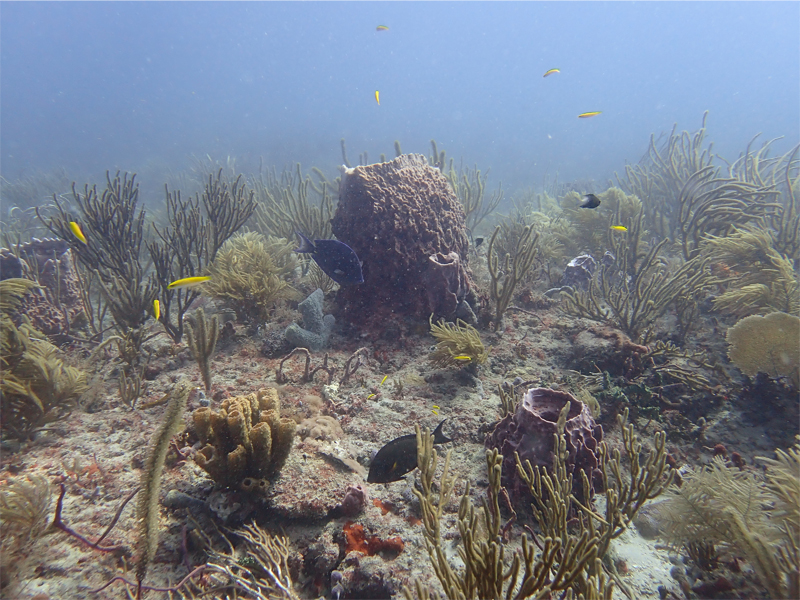
Florida corals, fish, and (probably) some fish feces too! (Photo credit: C. Grupstra) |
To understand which symbionts might improve coral resilience through this pathway, Master’s student Div Sukhari is developing a model system with nudibranchs (sea slugs) and anemones. Div allows nudibranchs to eat anemones (just like fish eat coral) and then exposes anemones without symbionts to that nudibranch poop to see if they acquire symbionts. This model system can test the same symbionts that are found in coral and more easily identify which symbionts survive being passed through the digestive tract. Are those symbionts more thermally tolerant? Div’s research will help identify strong symbiont candidates for improving resilience through these “pooping partners.”
Grupstra’s Ph.D. student, Rose Santana, is investigating how coral cryptic genetic diversity may influence resilience.
“Corals have really high levels of ‘cryptic genetic diversity’ which means what we think of as only one coral species could actually be many different species. Corals tend to ‘self-sort’ across the reef. In shallow areas of the reef, you find one cryptic species, but a little deeper, you might have a different cryptic species.” Grupstra explains. Although they may look the same, Grupstra’s Lab is learning these cryptic species can respond very differently to stress and may have different survivorship rates as well.
At the root of studying resilience is hope – hope that coral can thrive in a changing environment. Around the world, coral reefs are dwindling and news outlets are full of doom and gloom as once vibrant reefs face the threat of intense and rapid warming. Is the future bleak?
Grupstra said, “Coral probably won’t disappear entirely, but Florida reefs will look different. Coral species that used to be the most abundant and iconic, like staghorn and elkhorn corals, do not do well at these higher temperatures.”
|
|
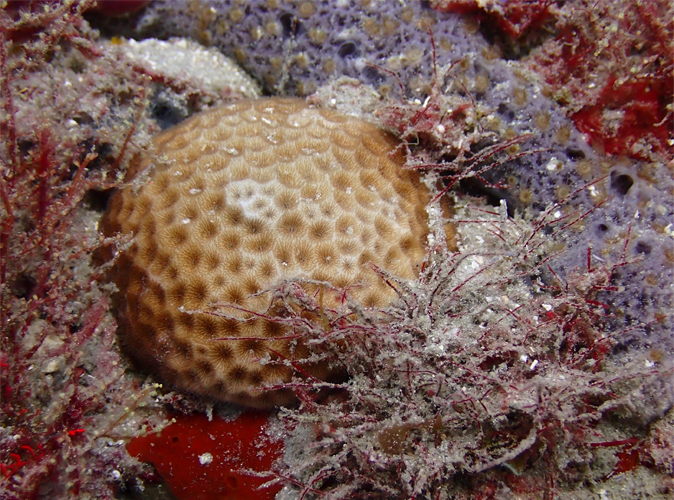
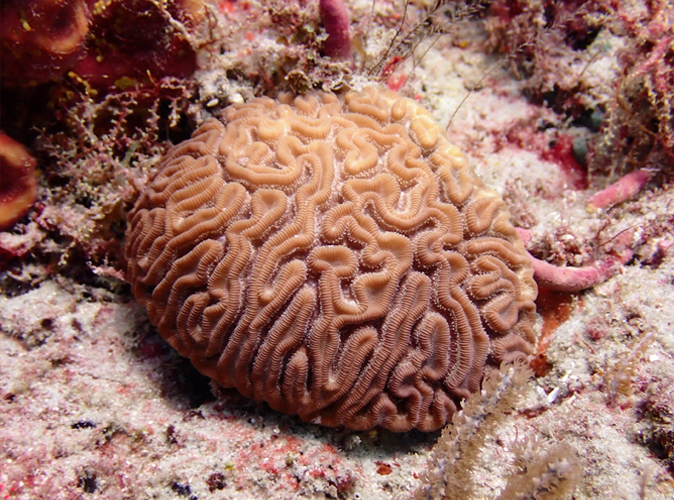
| Boulding corals (Photo credit: C. Grupstra) |
He goes on to explain that there was a big loss of corals at first, and now we are experiencing a big shift in which corals live on our Florida reefs. We are seeing more stress-resistant bouldering species that survive relatively well. And, Grupstra surmises, we may start seeing coral farther north in latitudes that were previously too cold. He also has high hopes for “hero” coral species that seem to adapt to different conditions. One might compare them to raccoons or coyotes of the sea – finding ways to live and thrive in rapidly changing, human-altered landscapes.
Dr. Grupstra and his students have already made the Marine Lab their home and have many new projects in the pipeline! We are so excited to have coral in the lab and to share coral research with our community. Visit the FAU Marine Lab to see this new, innovative research in real-time!
