Colleen Hecker and Author: Sam Trail
Date: September 24, 2026
During her master's degree at the Florida Atlantic University Marine Lab and as a Glenn W. & Cornelia T. Bailey SEA Scholar alumnus, Colleen Hecker, completed a thesis on octopus genetics. She thoroughly enjoyed the work, but there was one major challenge:
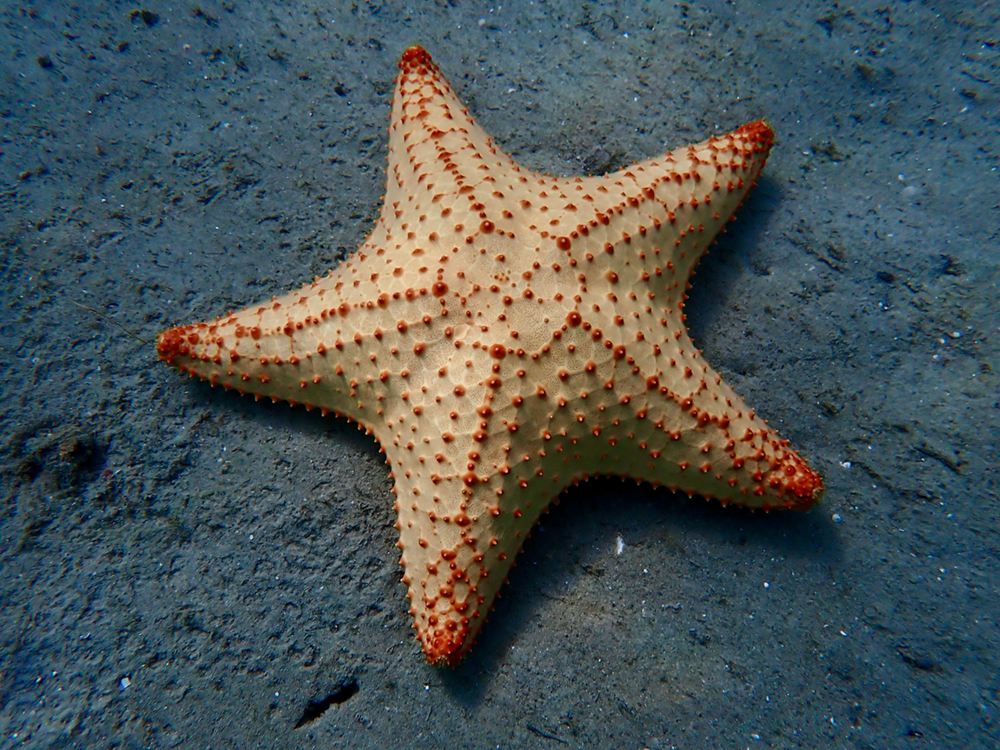
“I was not very adept at spotting these masters of disguise, which was a bit frustrating. However, I noticed that my study site was home to a booming population of bright red cushion sea stars (Oreaster reticulatus). These brightly colored, densely populated animals are larger than dinner plates, and they were impossible to miss!” joked Hecker.
|
|
Healthy red cushion sea star. Photo credit: Miranda Manross |
To her surprise, no one was studying this large assemblage of sea stars. Her self-diagnosed ineptitude of octo-observation led her to ponder a new and interesting question worthy of investigation: Could these plentiful and ubiquitous red cushion sea stars be used as indicators of ecosystem health in Florida's Lake Worth Lagoon? This fundamental question forms the foundation of Hecker’s current Ph.D. dissertation in Florida Atlantic’s Integrative Biology program.
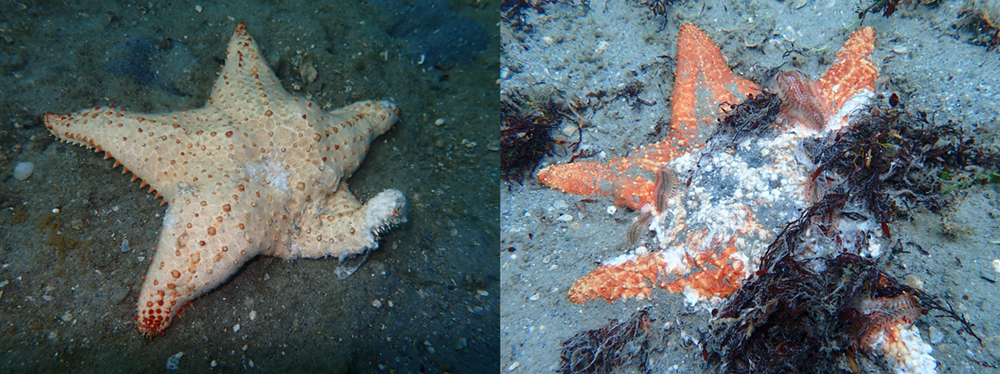
Hecker’s Ecology of Infectious Marine Diseases class introduced her to a mysterious syndrome called Sea Star Wasting Disease. This disease causes sea stars to lose their limbs, disintegrate, and die. In 2013-2014, this disease instigated the largest marine animal mass mortality event in the recorded history of the North American Pacific Coast. It affected at least 24 sea star species and killed over 1 billion sea stars. What followed was a population explosion of sea star prey (sea urchins) that overran kelp forests and wreaked havoc on that ecosystem’s biodiversity. Hecker immediately thought of Florida's sea stars, which had never experienced wasting disease.
“I wondered why our sea stars had stayed healthy while so many had died in other areas. A lot of the literature on sea star wasting disease noted that, in sick animals, microbiome communities underwent changes in both taxonomic composition and metabolic function. I therefore decided that my future PhD dissertation should focus on defining the baseline microbiome of Florida’s healthy sea stars.”
Then something truly unexpected happened. In 2025, a paper was published in the Southeastern Naturalist that described a nine-armed sea star (Luidia senegalensis) wasting disease event at south Florida's MacArthur State Park. This location was just a stone’s throw away from Hecker’s own study site at Phil Foster Park, located at the Blue Heron Bridge.
|
|
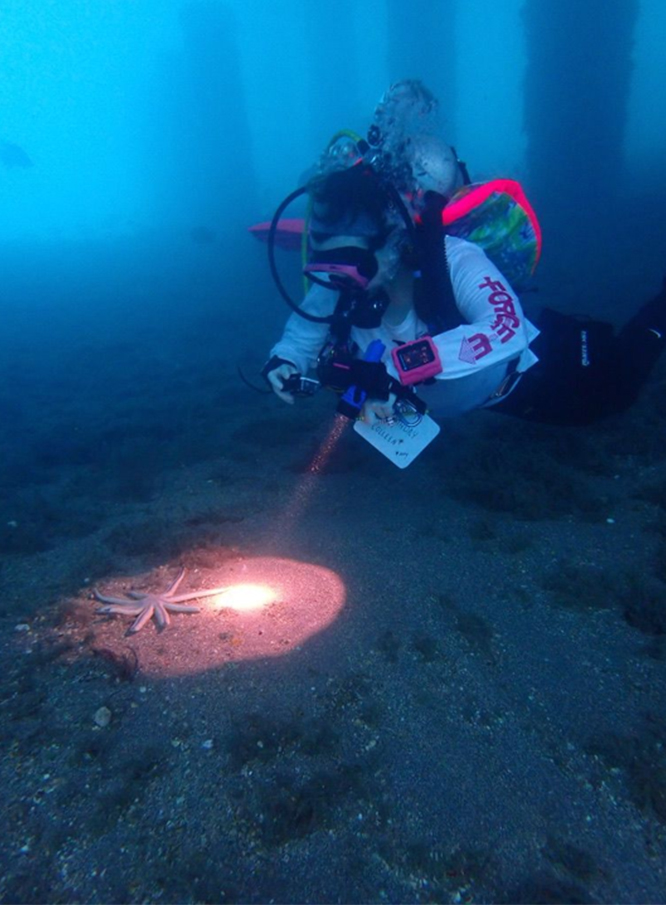
FAU Ph.D. student Colleen Hecker in field with a 9-arm sea star. |
“I was shocked. Here I was, only a few miles down the road surveying a perfectly healthy population of sea stars, while a catastrophic wasting event had unfolded nearby that was completely unbeknownst to me. This event took place over two days (July 6-7, 2024) and my birthday is July 7…coincidence? I think not – I was born for this study!”
To make matters worse, shortly thereafter Hecker began to observe sea star wasting disease at Blue Heron Bridge. She was devastated but determined to do something about it!
Hecker needed to expand her study area to cover more space and with more eyes. Her solution? Effective science communication and citizen science. Citizen science is an opportunity for community members to participate in scientific projects, expand our knowledge of problems, and have a positive impact on the environment. Hecker, along with her lab mates, gave a short presentation at a local dive shop (Pura Vida Divers). At that talk she learned that some audience members had also seen sea star wasting disease at local sites but hadn't known what it was.
“So, I launched Sea Star Stewards. This is Florida's first citizen science initiative, one that functions to collect sea star wasting disease observations.” Hecker proudly explained. “Programs like mine empower the community to interact with and participate in scientific research…because science is for everyone!”
Citizen science is important to Hecker’s project as it promotes local awareness of sea star wasting disease and helps her track its location, timing, and scale. Her dissertation integrates microbiology, water quality analysis, and population surveys to better understand the impact of sea star wasting disease. There are several possible causes – hypotheses range from viral and bacterial pathogens to abnormalities in the sea star’s microbiome or its environment. It’s possible that no single causative agent will ultimately account for all aspects of sea star wasting disease across time, space, and the species affected.
|
|
Different stages of sea star wasting disease. Photo credit: Miranda Manros |
“I am only one person and cannot dive every day to look for sea star wasting disease (though I truly wish I could). Sea Star Stewards is an extremely important aspect of my study as it harnesses the power of community to track the impact of the disease, locally,” Hecker explains.
Currently, Florida seems lucky in comparison to the Pacific Coast. The 2024 wasting event at MacArthur State Park is only known to have affected 50-75 nine-armed sea stars, and even fewer red cushion sea stars at the Blue Heron Bridge. However, sea star wasting events throughout history are characterized by rapid, large-scale mortality events. It is imperative that the local community remain on alert and that we all do our part to keep an eye open for this disease.
Please, if you are diving, snorkeling, swimming, or hanging out at the beach, and you see a sea star, give it more than a passing glance! Familiarize yourself with the signs of sea star wasting disease on Hecker’s Sea Star Steward website. If you think a sea star might be diseased, snap a picture and submit it through the citizen science portal. If you can't take a picture, you are encouraged to contact Colleen with an email message that describes your sighting (her address: checker2018@fau.edu).
