Author: Kristan Reynolds
Date: December 10, 2025
All aboard! For this train, you don’t need a golden ticket — just fins and sharp teeth. Every winter, thousands of blacktip sharks embark on a seasonal journey, or migration, believed to be initiated by environmental factors.
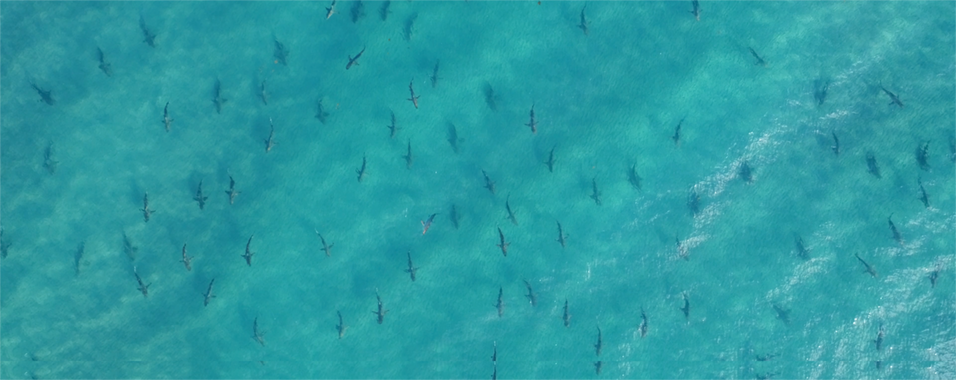
Meet the conductor: Dr. Stephen Kajiura, a Florida Atlantic University Professor and Primary Investigator studying these sharks, and also affiliated with the Marine Lab. He and his research team have been observing this migration from overhead, by flying over the shallow and clear coastal waters along the US East Coast. Their observations have been continuous for more than 15 years — one of the longest running shark aerial survey programs ever conceived!
Blacktip sharks arrive in southeastern Florida in January. Numbers peak in mid-February, then decline as the sharks head north again in March or April. They travel rapidly up the coast, gathering in mating areas off the coast of Georgia and the Carolinas, before continuing to swim as far north as Long Island, New York.
According to Dr. Kajiura, these movements aren’t random. They’re driven by a combination of environmental signals with one clear leader.
“Longer day lengths mean that the water can be warmer, and with more sunlight and warmer water, phytoplankton (tiny, plant-like organisms) bloom and reproduce. Their higher productivity will attract more little fish (the prey for the sharks)” said Dr. Kajiura. “So, all these things are interrelated, but at the heart of it, is temperature.”
However, Dr. Kajiura has noticed a major change off the coast of southeastern Florida since the beginning of his team’s survey activity.
“When we started this project, we used to see huge numbers of sharks massing by the thousands right against the beach,” said Dr. Kajiura. “But now, within the last few years, the number of sharks we see during our aerial surveys has declined to a tenth of that.”
According to Dr. Kajiura, this decrease is due to warming water temperatures as sharks’ preferred winter water temperature is now found at higher latitudes, creating a significant shift in the shark distribution.
Based on historic data, the National Marine Fisheries Service’s current designated fish habitat for these blacktip sharks — which provides regulations and management of sharks within that area — ranges as far north as Virginia or Delaware. However, the new data now demonstrate that, as global temperatures rise, designated habitat for migrating blacktip sharks may need updating to include more northern waters.
“Blacktips are going all the way up to the eastern tip of Long Island — that’s a much farther northern distance,” said Dr. Kajiura. “And that area has no regulations for blacktip sharks, so now you have thousands of blacktips potentially available for exploitation, simply because they are outside of a management district.”
Sharks tend to stay within their preferred temperature range by moving toward warmer waters in the winter and cooler waters in the summer. These massive winter aggregations are almost entirely males — over 95% — and individuals are nearly all the same size. Dr. Kajiura says the size could be linked to efficiency of transportation. “If you're all different sizes drafting off the vortices produced by the shark in front of you, a tiny shark is not going to be particularly useful,” said Dr. Kajiura “If it's one that's way bigger than you, it's going to be disruptive. But if it's about the same size, you're able to draft off it more effectively.” This “strategy” is akin to following a car of similar size on the highway to save fuel.
As for why these migrations are almost entirely male-driven, Dr. Kajiura theorizes that because some females are pregnant, they are simply not able to migrate as far as the males. Pregnancy makes it more “energetically expensive” to travel such distances. Dr. Kajiura adds that the females may be doing a shorter migration or meeting different food requirements elsewhere.
With the shark migration right around the corner, seeing sharks in large numbers will be a sign that conservation efforts are working.
“It's a good thing when you see lots of sharks,” said Kajiura. “It's indicative of an ecosystem that's healthy enough and robust enough to support large numbers of these top-level predators.”
However, as rising global temperatures continue to reshape migration routes, management strategies will need to adjust appropriately.
While the Polar Express makes its winter journey north, remember the Solar Express is traveling the opposite direction just offshore — guided not by rails or tickets, but by temperature, efficiency, and a rapidly changing ocean.
