Author: Maggie Dalby
Date: June 25, 2026
It’s sea turtle nesting season in Florida, and June is an especially busy time. The temperature, the number of nests, and the number of emerging hatchlings are all on the rise. So, too, are the number of sea turtles filling our tanks at Florida Atlantic’s Marine Science Lab!
For over 20 years, Dr. Jeanette Wyneken has brought a subset of healthy hatchlings to the Marine Lab, sampled from local nests laid across the beginning, middle, and end of the nesting season. These hatchlings help us estimate the proportion of male to female turtles produced on our beach, otherwise known as the site’s “primary sex ratio.” These ratios are of particular interest to scientists and conservationists, because sea turtles do not have sex chromosomes (X or Y) like humans. Whether sea turtle embryos develop into males or females depends upon environmental conditions during incubation, primarily the temperature and moisture content of the sand inside the nest. The process of becoming male or female under these conditions is known as environmental sex determination. Hot and/or dry nests (over 31°C or ~88°F) will produce all females. Relatively cool and/or moist nests (below 27°C or ~81°F) will produce all males, and conditions in between will produce combinations of both sexes. To simplify, the basic rule is “Hot Chicks and Cool Dudes!”
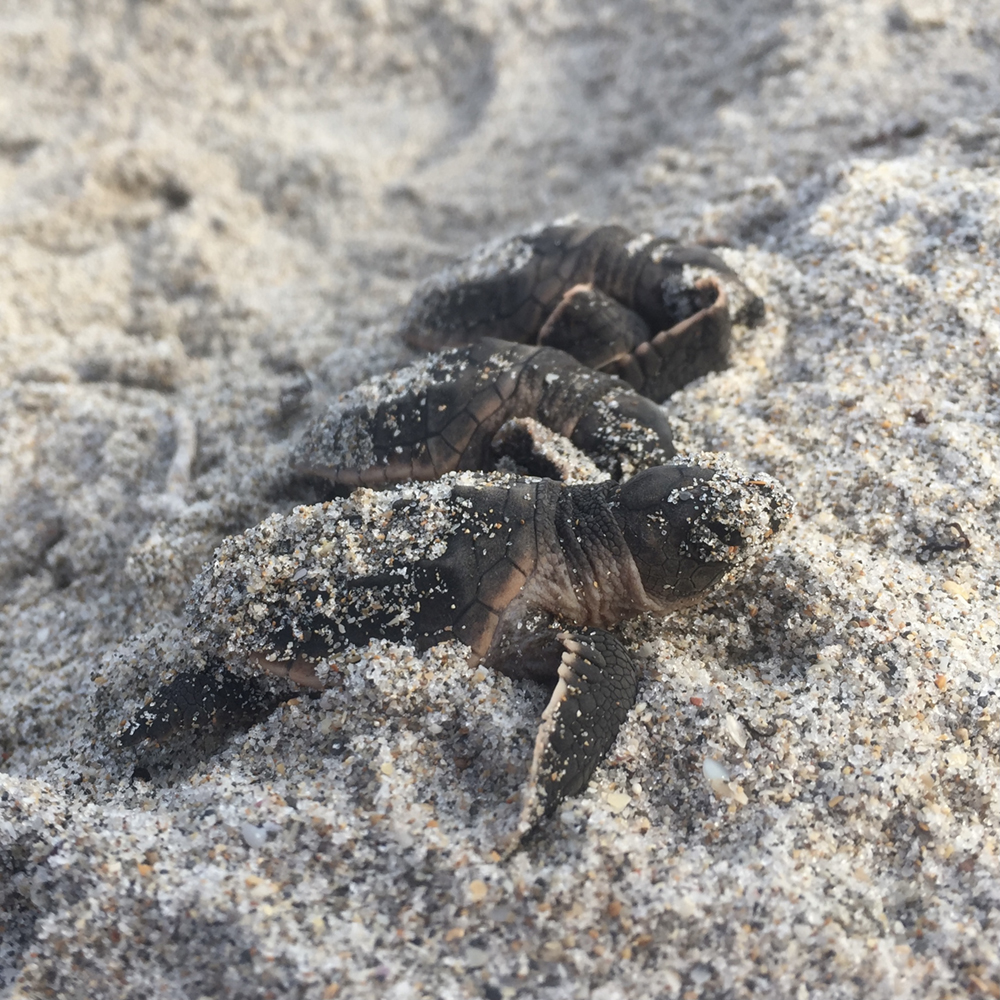
The hatchlings that enter the Marine Lab remain with us, on average, for about 3 – 4 months until they are approximately the size of your hand (at which point they weigh ~120 grams, or less than half a pound). Sea turtles will not show external male or female characteristics until they reach maturity (around 15 – 30 years old, depending upon the species). However, we use medical imaging to peek inside the young animals and examine their developing sex-specific organs. Those observations make clear their eventual sexual identity. A week or so later, after the turtles recover from the minor procedure, they are released well offshore into the open ocean!
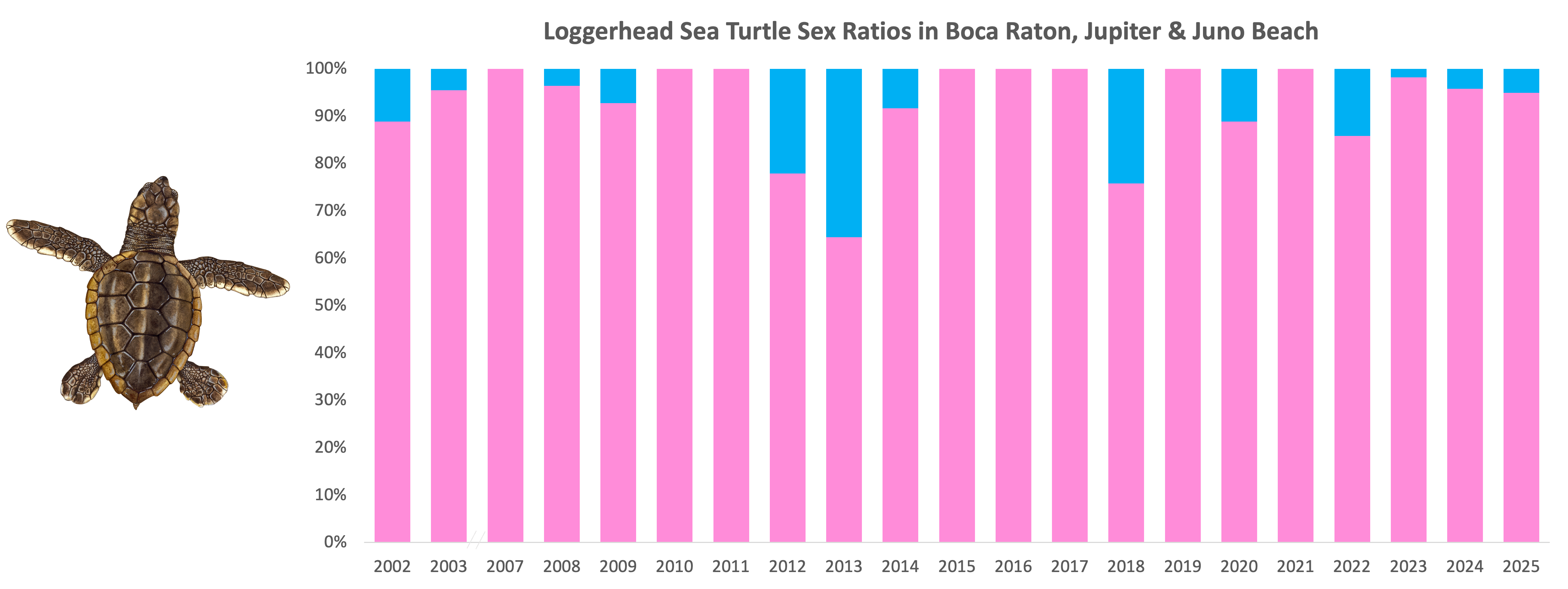
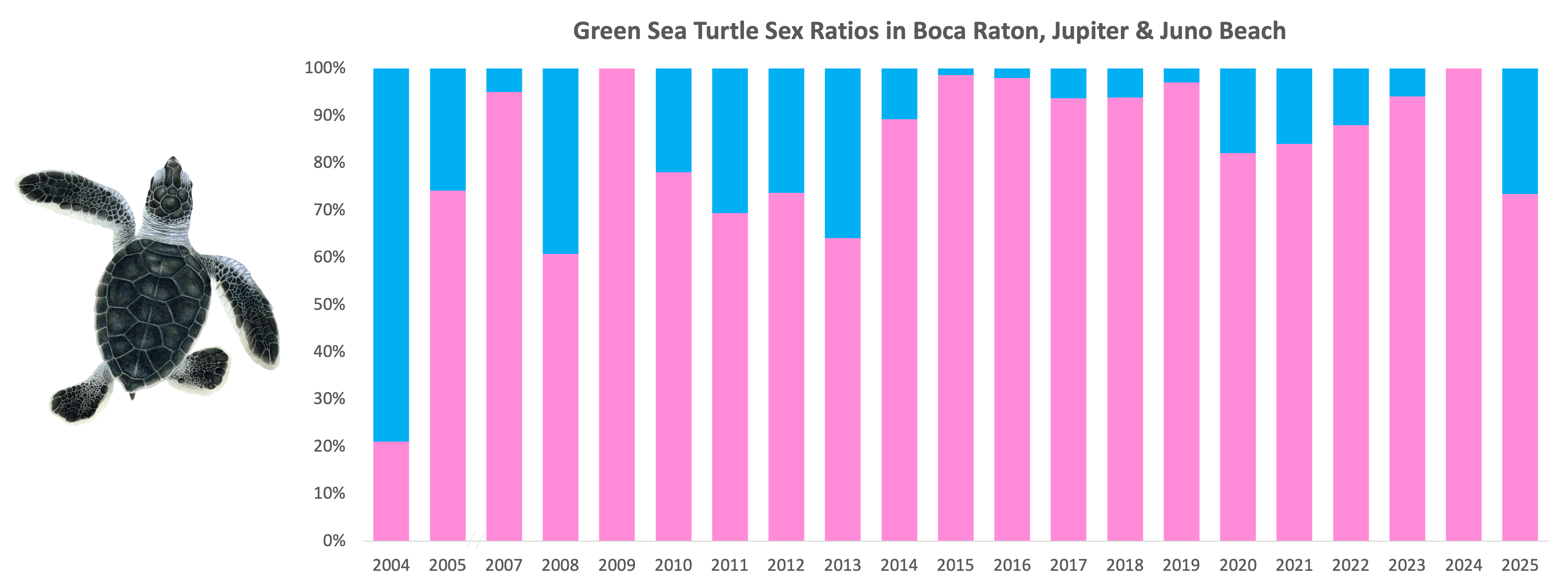
The sex ratios we observe each year over the entire nesting season will eventually be compared to the data obtained over previous years so that long-term trends can be identified. Such long-term data are essential for determining if a pattern of change is taking place.
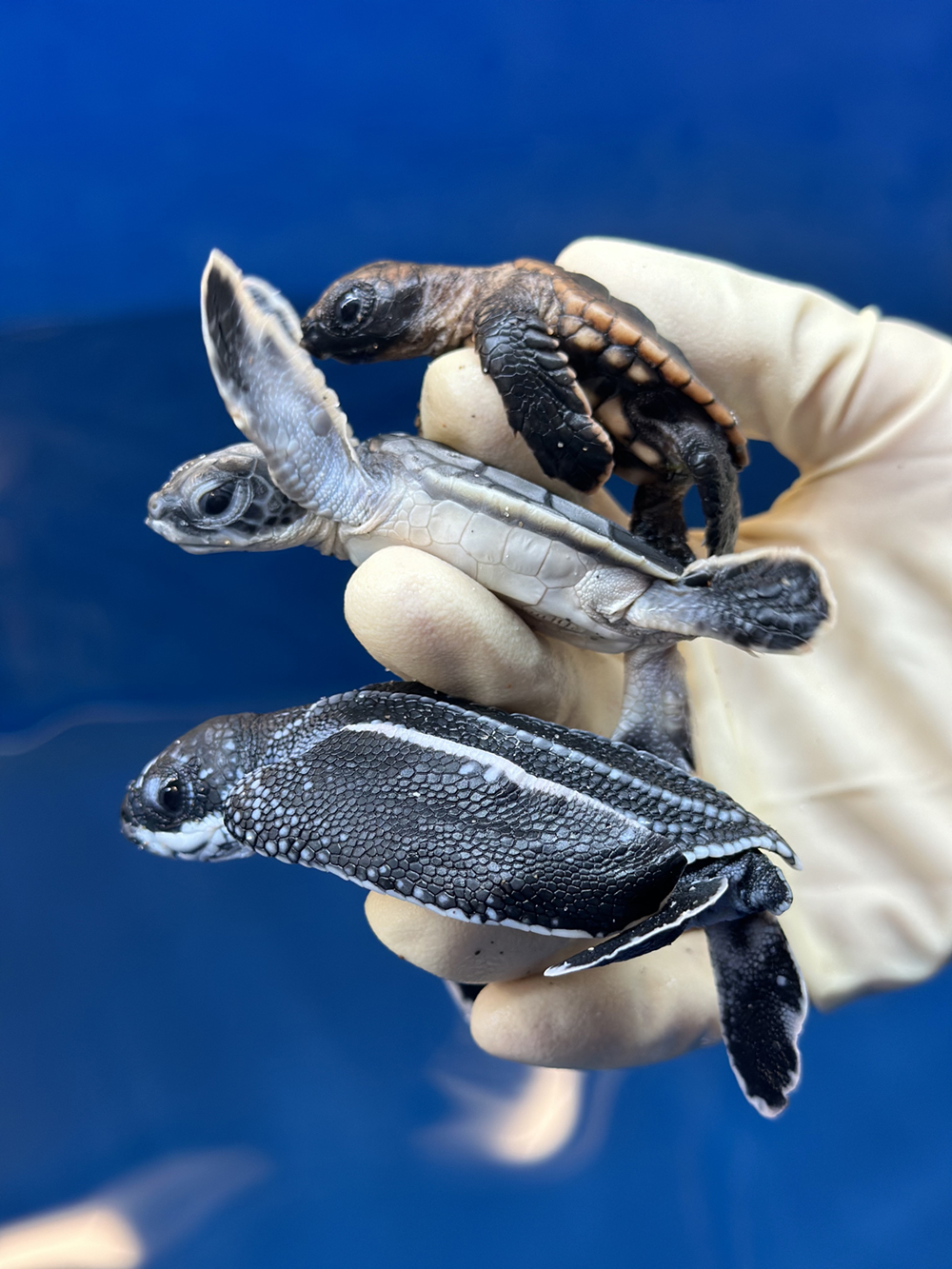
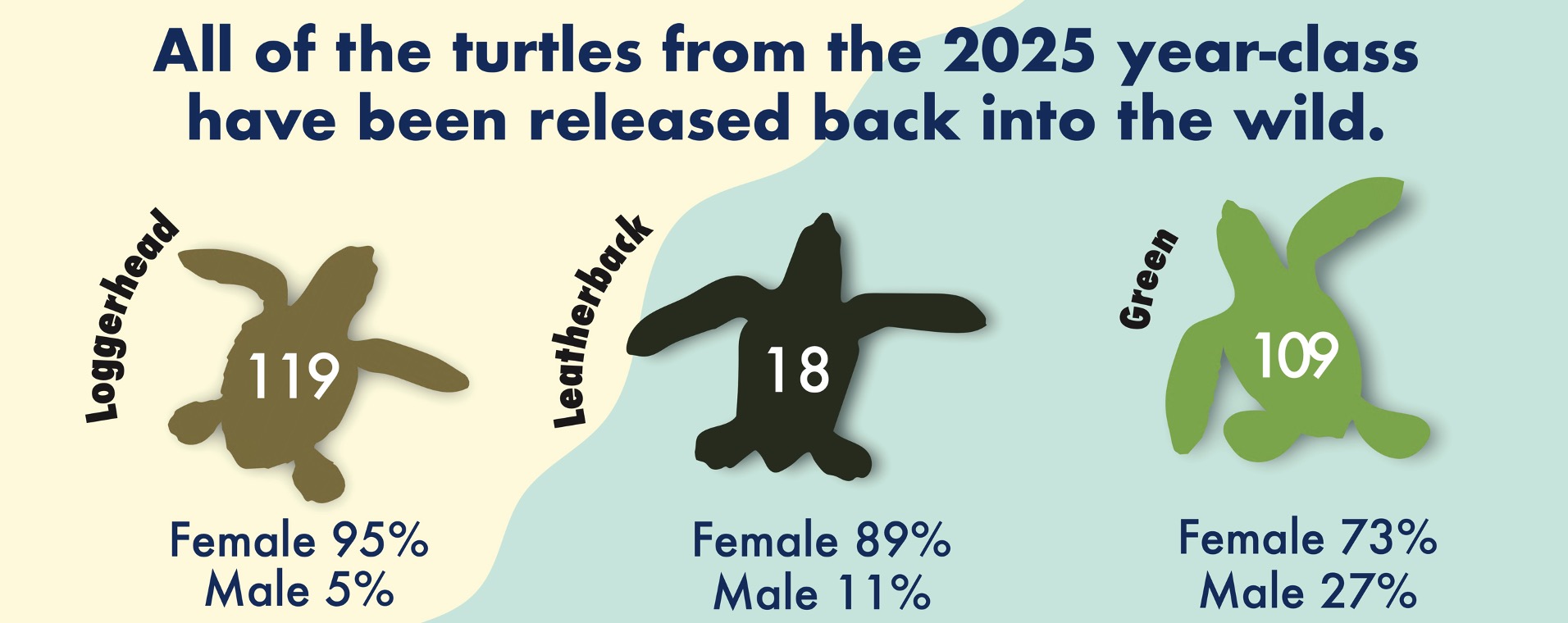
During the 2025 season, the Marine Lab housed and released hundreds of turtles. Of the many thousands of sea turtle hatchlings that emerged on the monitored beaches of Boca Raton, Jupiter, and Juno Beach, Florida, we brought in and identified the sex of nearly 250 young turtles – 18 leatherbacks, 119 loggerheads, and 109 green turtles.
Due to the warm temperatures during sea turtle nesting season (spring – summer), most of the hatchlings in our lab and produced on our beaches are females. That is the normal pattern for most populations of sea turtles. But nowadays, in some years, we do not find a single male! In 2024, for example, we found very few male loggerheads and no male green turtles. That outcome is distinctly abnormal, and a cause of concern for sea turtle biologists!
In 2025, we were excited to find that all three species produced males! About 11% of our leatherback hatchlings, 5% of our loggerhead hatchlings, and 27% of our green turtle hatchlings were male. Although males were still abnormally few, those ratios were notable for the future of southeast Florida’s nesting populations!
With each successive year having record-high temperatures, our nesting populations risk reaching a tipping point, such that there are too few males to ensure the long-term survival of the population. We always celebrate when we can confirm there are a few more males in the mix!
Our focus now is on our rearing of increasing numbers of 2026 hatchlings, and the relationships between the nest temperatures we record at the beach and the sex ratios that the turtles show. Make sure to stop by to see these new turtles, and be sure to check back in to learn what they tell us about the primary sex ratios we’ve observed in 2026!