Author: Sam Trail
Date: November 19, 2025
Scour the library of any sea turtle biologist, and you will be hard-pressed to find a bookshelf without the works of Dr. Archie Carr — a famed professor at the University of Florida and leading authority on sea turtle biology and conservation during his lifetime. He was not only a profound scientist but an impressive science communicator. He authored many books that sparked curiosity of sea turtles in seasoned scientists and laypersons alike.
One of Carr’s most renowned books — So Excellent a Fishe — continues to provide the foundation for studies on sea turtle biology, behavior, and conservation. As turtles are notably not fish (or fishe) — Carr’s title comes from one of the first known attempts to protect sea turtles from being overharvested, a law passed by the Bermuda Assembly in 1620 and quoted in the book jacket, inhibiting fishermen whom:
“…snatch and catch up indifferentlye all kinds of Tortoyses both yong and old little and great and soe carrye awaye and devoure them to the much decay of so excellent a fishe.”
This quote sets the stage for both the plight of and wondering about sea turtles described in the pages to follow. Nearly 60 years later — thanks to new technologies — what were curiosities on Carr’s pages of natural history, are now, in many cases, facts supported by data and observations and definitive theories interpreting those constellations of facts. One such curiosity is where turtles travel between entering the ocean as newly emerged hatchlings and returning to beaches as mature nesting females.
Carr began collecting data to answer this question in a rudimentary, yet innovative way — attaching a cow-ear tag to the flippers of nesting females. Each tag was inscribed in both English and Spanish with a number and the offer of a reward to anyone who finds that tagged turtle. Carr was true to his word sending five dollars (somewhere between $45-$60 today) to all that wrote to him with recovered tags and locations! This creative crowdsourcing initiative began piecing together glimpses of where turtles were found (at least when in close proximity to humans) over time. Originally zoologists believed turtle migrations were only tales of fishermen, but Carr’s tagging project was slowly painting a different picture. Yet, these intermittent tag-recovery data only reflected locations of adult female turtles, as males in the Caribbean where he worked never returned to land and tiny hatchlings could not be tagged in this way.
Carr often felt mocked by sooty terns — migratory birds that are far easier to tag at all fledged life stages. He jokingly expressed an envy of tern banders that was “aggravated by the sooty tern so often nesting in the same places as the green turtles” he was studying. Carr maintained the ideal way to track turtles cruising in the open sea would be by satellite — an idea at the time that he dismissed as “grandiose daydreaming.” And yet…!
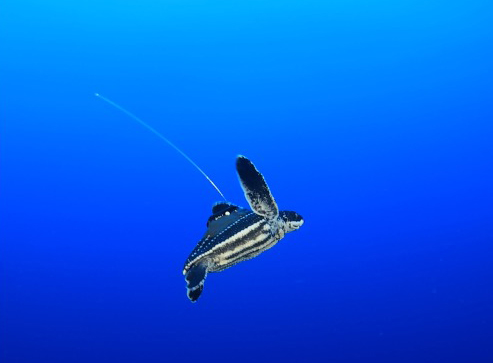
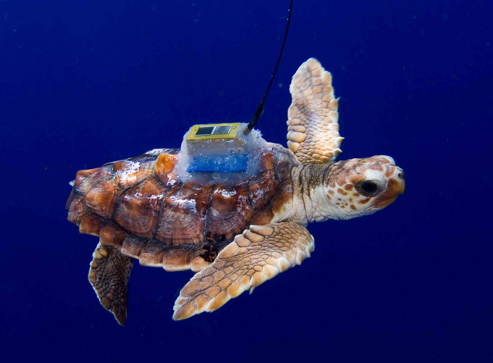
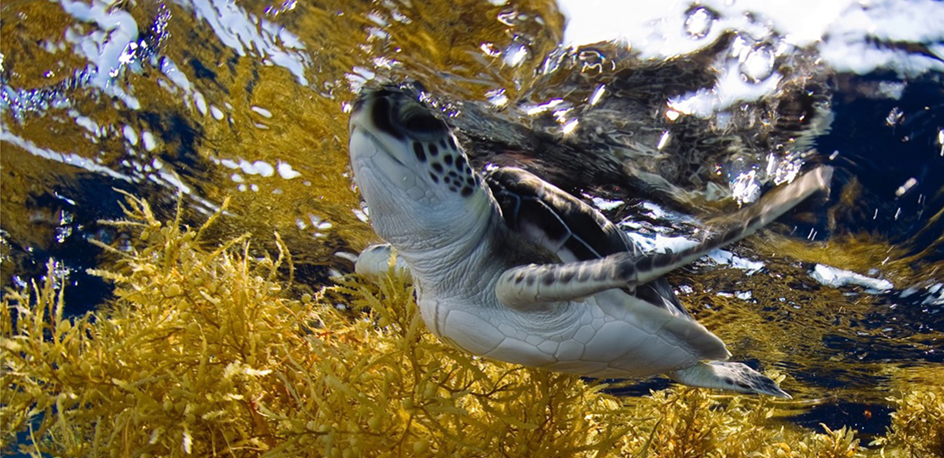
At the Florida Atlantic Marine Lab, we have released many turtles after their short time with us affixed with satellite tags — some tags not much larger than your thumbnail! Those tiny tags are adhered to the top of the shell (carapace) and communicate with orbiting satellites when the turtle is at the surface of the water. Our satellite tagged turtles have been tracked up to seven months and reveal the at-sea movements of turtles that so intrigued and alluded Carr. Our collaborative tagging data support Carr’s hypotheses that young turtles use the fast-moving currents of the Gulf Stream to displace them north- and east-ward and yearling turtles find refuge in floating mats of sargassum seaweed.
|
Photo credit: Jim Abernethy |
|
Along with advances in tagging, scientists continue innovating to unravel the mysteries of sea turtles that fascinated Carr. How do turtles navigate a vast ocean from foraging to nesting grounds? What cues do hatchlings use to find the ocean after emerging from subsurface nests on the beach? We now know the answers to these questions and others!
Dr. Michael Salmon, research emeritus professor of biology at Florida Atlantic University, and a frequent user of the Marine Lab, recently published a book — All About Sea Turtle Behavior: Essays for the Curious Naturalist — which compiles key insights in sea turtle research since Carr’s publication. In Salmon’s own words: “This collection of essays is meant to summarize for the curious naturalist what I think are the most important details we’ve learned about the current status, evolution, behavior, and (to a more limited degree) sensory capabilities of marine turtles since Archie Carr published his famous So Excellent a Fishe in 1967.” Just as Carr’s book was filled with more questions than answers, Salmon hopes these informative essays pique the curiosity of readers and inspire them to learn more about sea turtles. Read more about Dr. Salmon’s book here.